 215 215 9814
Full Day - 8 hours
English
Full Day - 8 hours
English
Full Day - 8 hours
English
Full Day - 8 hours
English
The island of Kefalonia (also spelled Cephalonia) is a popular destination among tourists who visit the Hellenic territory. It is located on the Ionian Sea, in the west of mainland Greece.
Its soil is rocky and the coastal area usually has cliffs, bays, and narrow strips of fine whitish sand.
The capital is Argostoli and it is characterized by maintaining the beauty of Greek architecture. You can also visit different towns, such as Assos, Farsa, Lixouri or Fiskardo, all with a particular attraction.
Kefalonia has it all: from resorts ready for you to enjoy an afternoon spa, to activities on land or sea for you to have a great time.
There are two ways to get to Kefalonia: by plane or ferry. On the one hand, the island has the Kefalonia International Airport. In less than an hour, you can travel to any other Greek destination or vice versa.
On the other hand, the island has five ports, so traveling to Kefalonia by ferry is a good option. You have connections to islands like Lefkada, Zakynthos, and Kyllini.
Depending on your needs and time, you can choose either of the two options. You choose!
In the following lines, we are going to recommend what to see in Kefalonia. In the case of this island, the ideal would be to rent a car to get to know the main attractions comfortably. Another very good option is to hire excursions that take you to the most important sites.
This city is one of the most important of the Ionian Islands. It has views of the Koutavos lagoon and is relevant for its geographical location.
Many of its buildings come from the Venetian tradition, most of which were destroyed during an earthquake in 1953. Among them, the Kosmetatos Residence and the De Bosset Bridge, the longest stone bridge in Europe, resisted.
It also has a huge tower-shaped building, called the clock tower, an archaeological museum, and multiple churches, including the Church of Saint Nicholas, the only Catholic church on the island. Among its streets, you can discover a variety of restaurants and regional products for sale.
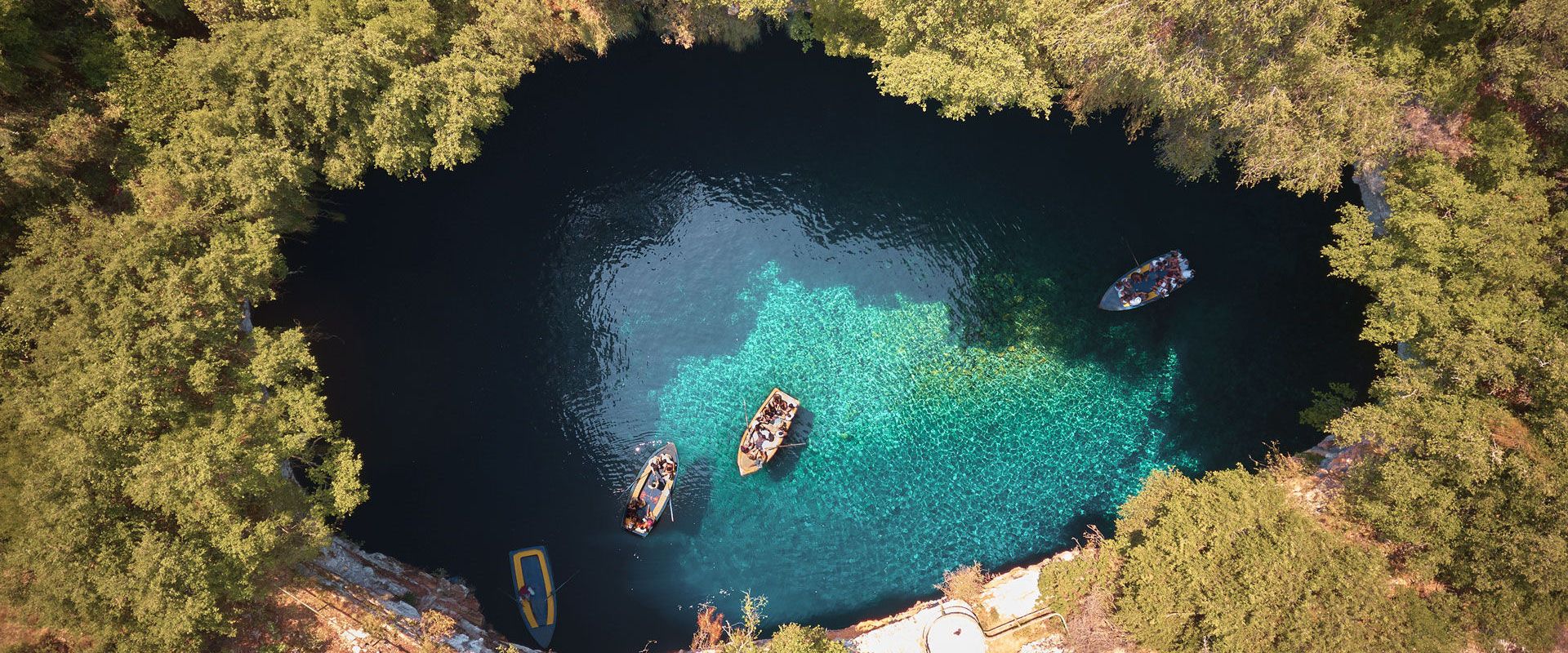
Two must-see attractions if you are on the island of Kefalonia, typical of nature, which can be navigated as tourist attractions.
Lake Melissani is said to have been home to the nymphs, while Drogarati housed them. In the latter case, it is a cave with formations of stalactites and stalagmites that dates back to around 150 million years old.
In both attractions, you must pay to visit their spaces on top of a boat and with a guide.
This park is the highest point of the island, at 1628 meters of elevation.
The car route to get there is beautiful, although it is the only one both to go and to return.
Inside the park, there are different paths to follow and, in good weather, you will be able to observe a large part of the island in a panoramic way.
Located in the capital, Argostoli, it is an imposing white lighthouse, in the center of which a golden light shines to guide boats.
Its building deals with Greco-Latin architecture and is located at the end of a rocky walkway, surrounded by the sea.
It is less crowded in the morning, although it is open to the public 24 hours a day. It serves as a panoramic point to observe the splendor of the entire island.
It is located on the Paliki peninsula, 15 km from Lixouri village, on top of a mountain 90 meters above sea level.
It was founded in the seventeenth century and its name means “the monastery of the gardens”, due to the number of gardens that this monastery has, which were once cultivated by thousands of monks.
On our days, only one monk stays at this location and it is open to tourists.
Also called the Castle of Saint George, it is located approximately 7 km from the capital of Kefalonia and dates from the year XII.
It is a construction made by the Byzantine Empire. Normally it can take about 2 hours to go through it completely.
Its hours are from 08:30 a.m. to 4:00 p.m. and it is busiest during midday. Watch out! On Tuesdays, it is closed to the public.
If you are looking to experience new flavors and recipes, be sure to try the products of the Kefalonia region.
On the island, they specialize in harvesting vines to produce wines, especially the variety of white drink called Robola. A delicacy!
The families are also dedicated to planting dried fruits, such as hazelnuts and walnuts. From them, they make typical desserts like baklava.
If you like, you can consider homemade cheeses and yogurts. There, the different local factories that use goat's milk for their manufacture stand out.
Most of Kefalonia's cheeses are called feta, a mixture of goat and sheep's milk, although you can also find other equally delicious varieties such as kefalotiri and gravieta, hard cheeses that are often used with pasta.
The traditions of Kefalonia are very moving and envelop a certain atmosphere of magic since the island is full of multiple legends and stories.
A romantic legend is linked to Lake Melissani, which is named after a nymph. In this attraction, archaeologists discovered an ancient clay sculpture of the god Pan and the nymphs. The story goes that she cried so much over an unrequited love with the god Pan that her tears formed the lake.
Nowadays, locals and visitors believe that if couples in love visit the lake and join hands underwater, as a ritual, they will stay together forever.
In addition, a festival dedicated to the Virgin Mary of Markopoulo is celebrated every August 6-15. Its church, in fact, is located on the island, and during this period it welcomes thousands of snakes, who are called "the snakes of the Virgin Mary".
A similar phenomenon is celebrated on the Day of the Assumption of the Mother of God, on the Feast of the Annunciation, where locals bring white lilies to the temple, which are left to dry for five months.
Finally, if you are interested in this kind of cultural festivities, we recommend that you visit the island in the last week before Easter.
During this time, the streets of all the cities of the island are filled with children painting clay jars on Holy Thursday, which they break the following Saturday in search of a rich harvest during the new planting season.
All the festivities are a good opportunity to learn more about the traditions and culture of the island and Greece itself!